Objectives
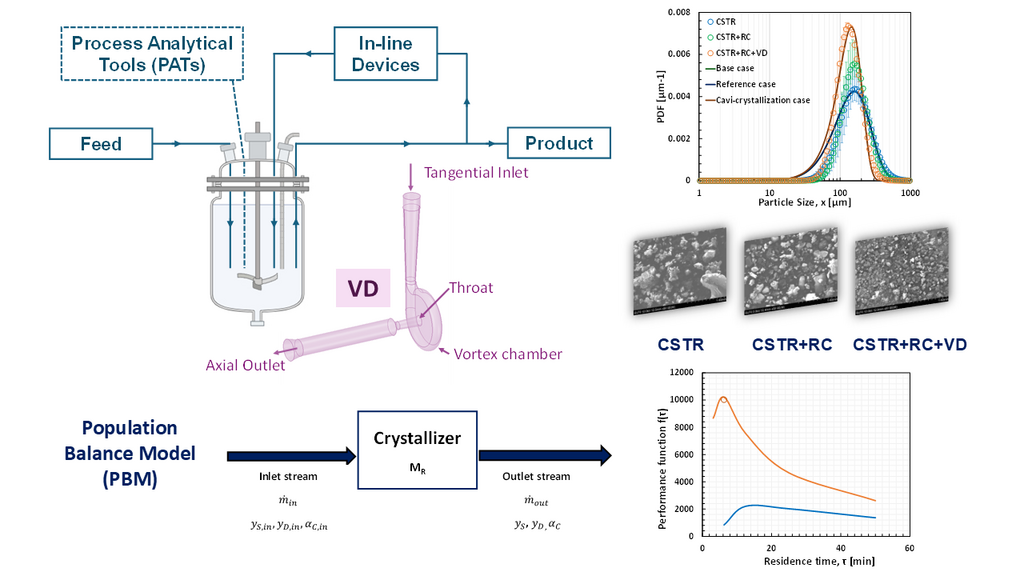
Develop a continuous antisolvent crystallization process integrated with hydrodynamic cavitation to investigate effects on the crystal size distribution and process performance.
Key findings
Relevance
Provides a scalable and energy-efficient strategy for producing smaller, more uniform pharmaceutical crystals while maintaining high yield and productivity in continuous manufacturing.
More details may be obtained from: Tiwari, V., Swain, S., Wagh, R., Bari, A., Ranade, V.V., 2025, Chemical Engineering Journal 520, 166207. https://doi.org/10.1016/j.cej.2025.166207.
Objectives
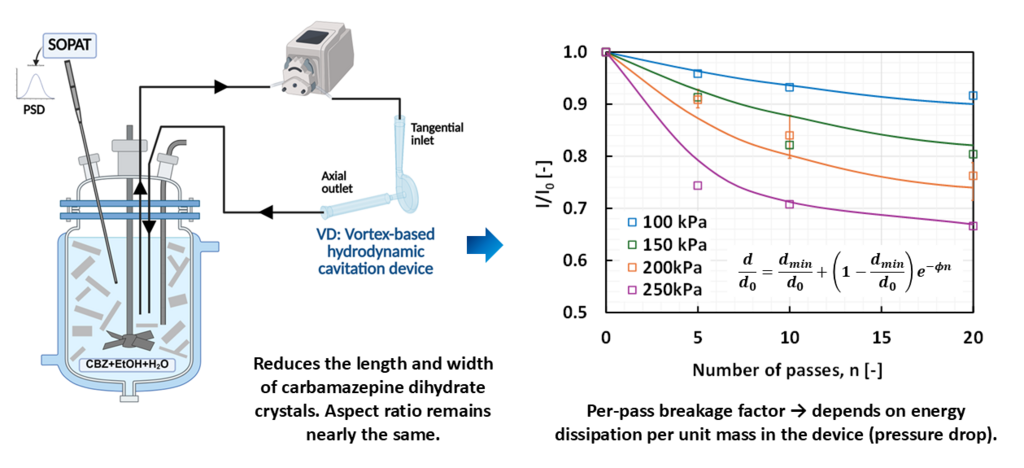
Investigate hydrodynamic cavitation-induced breakage of non-spherical crystals and develop a modeling framework to predict crystal size and shape in such systems.
Key findings
Relevance
Provides an energy-efficient alternative to conventional milling for tailoring pharmaceutical crystal size and shape while preserving crystal form and morphology.
More details may be obtained from: Swain, S.; Tiwari, V.; Ranade, V. V., 2025, Industrial & Engineering Chemistry Research 64, 20362–20375. https://doi.org/10.1021/acs.iecr.5c02950.
Objectives
Insert 2-3 lines elaborating on the objective of the current work.
Key findings
Relevance
The relevance of the current work.
More details may be obtained from: Chidambaranathapillai, S., Cravotto, C., Kamler, A.V., Nikonov, R.V., Sivakumar, M., Cravotto, G., 2025, Processes 13, 4033. https://doi.org/10.3390/pr13124033.

Objectives
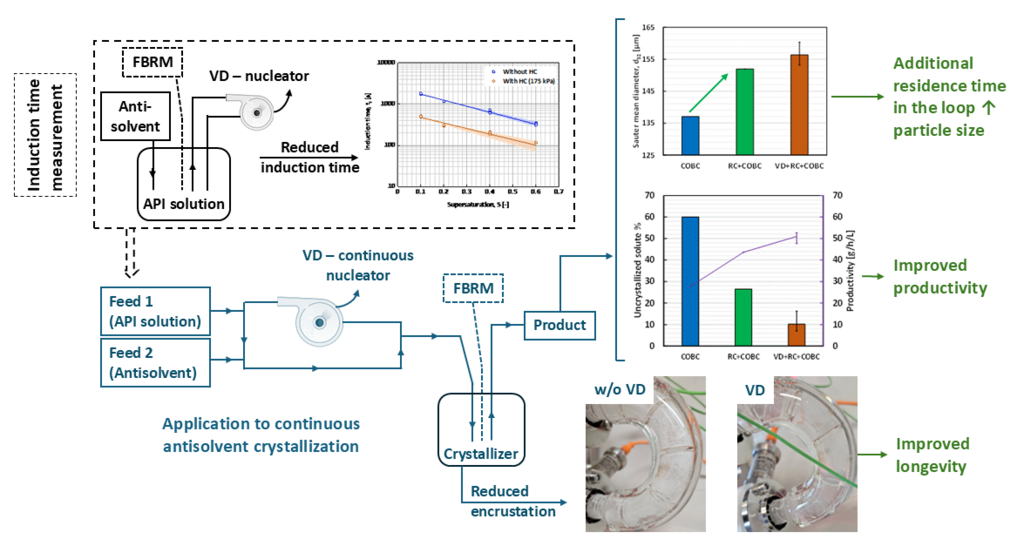
Investigate the use of hydrodynamic cavitation to enhance nucleation and intensify continuous antisolvent crystallization of paracetamol.
Key findings
Relevance
Provides a scalable and energy-efficient strategy to enhance nucleation, reduce fouling, and significantly improve yield and productivity in continuous pharmaceutical crystallization.
More details may be obtained from: Tiwari, V., Swain, S., Ranade, V.V., 2025, Ultrasonics Sonochemistry 123, 107668. https://doi.org/10.1016/j.ultsonch.2025.107668.
Objectives
Insert 2-3 lines elaborating on the objective of the current work.
Key findings
Relevance
The relevance of the current work.
More details may be obtained from: Toyran, E., Zupanc, M., Petkovsek, M., Dular, M., 2026, Ultrasonics Sonochemistry 125, 107741. https://doi.org/10.1016/j.ultsonch.2026.107741.
Objectives
Insert 2-3 lines elaborating on the objective of the current work.
Key findings
Relevance
The relevance of the current work.
More details may be obtained from: Liu, P., Chidambaranathapillai, S., Wu, Z., Cravotto, G., 2026, ACS Omega 11, 2384–2406. https://doi.org/10.1021/acsomega.5c08760.

Objectives
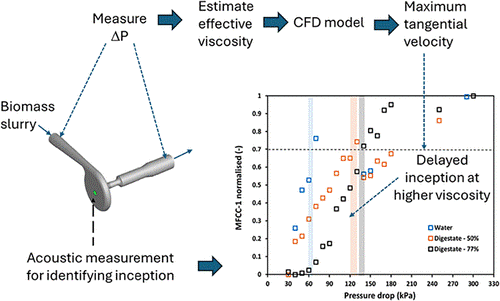
To investigate the influence of non-Newtonian, specifically shear-thinning fluid behavior, on the flow characteristics and cavitation inception in a vortex-based hydrodynamic cavitation device (VD) using experimental measurements and CFD simulations.
Key findings
Relevance
Provide a foundation for the design and optimization of VD for processing complex fluids and slurries encountered in waste valorization and bioprocessing applications.
More details may be obtained from: Upadhyay, M., Rathod, J., Ranade, V.V., 2026, ACS Engineering Au XX, XXXX–XXXX. https://doi.org/10.1021/acsengineeringau.5c00121.
Objectives
Insert 2-3 lines elaborating on the objective of the current work.
Key findings
Relevance
The relevance of the current work.
More details may be obtained from: Khare, O.V., Ranade, V.V., 2026, Chemical Engineering Science 331, 124032. https://doi.org/10.1016/j.ces.2026.124032.
This project has received funding from the European Union’s Horizon Europe research and innovation programme under the Marie Skłodowska Curie Grant Agreement No. 101113564 [February 2024 – January 2028].
© CaviPRO: CaviPRO@ul.ie